Modern Jive Quartet
Each card in the game represents a modern Jive move named after the Jive.Berlin curriculum. Cards contain up to six attributes, which describe the move as follows:
- Level: Moves are categorized into five levels:
- Level 1: Beginner moves, typically taught in your first Modern Jive class.
- Level 2: Moves that may require more practice.
- Level 3: Intermediate moves, requiring knowledge of techniques such as drops, hammer locks, or spins.
- Level 4: Advanced moves.
-
Level 5: Open-level moves, including aerials or those requiring special techniques or training.
-
Count: The count starts from the first rock step\ * on count one. Only full beats are counted, excluding the “and beat. ”
-\ *Note: A rock step can be a basic step back or a sideways step into a Wurlitzer position. - Turns: A full turn is considered 360° for one partner in one continuous motion. Two 180° turns with a step back in between do not count as a full turn. Leader and follower turns are added together.
- Change of Place: This indicates that both partners switch positions, fully passing each other. Ending up side-by-side does not count.
- Energy: This reflects the minimum energy required for the move to work. For example:
- Energy 1: Basic commitment.
- Energy 2: Requires a stronger connection.
-
Energy 3: Involves hammer techniques or a very strong connection.
- Trait: Additional information or characteristics about the move, such as specific techniques or elements.
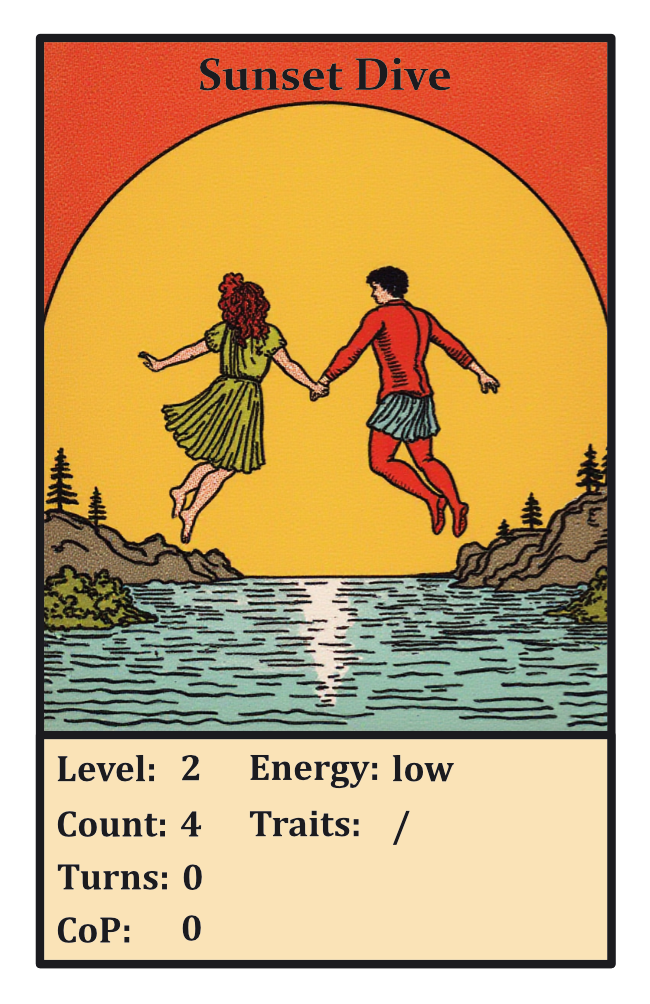
Each card in the game represents a modern Jive move named after the Jive.Berlin curriculum. Cards contain up to six attributes, which describe the move as follows:
- Level: Moves are categorized into five levels:
- Level 1: Beginner moves, typically taught in your first Modern Jive class.
- Level 2: Moves that may require more practice.
- Level 3: Intermediate moves, requiring knowledge of techniques such as drops, hammer locks, or spins.
- Level 4: Advanced moves.
-
Level 5: Open-level moves, including aerials or those requiring special techniques or training.
-
Count: The count starts from the first rock step\ * on count one. Only full beats are counted, excluding the “and beat. ”
-\ *Note: A rock step can be a basic step back or a sideways step into a Wurlitzer position. - Turns: A full turn is considered 360° for one partner in one continuous motion. Two 180° turns with a step back in between do not count as a full turn. Leader and follower turns are added together.
- Change of Place: This indicates that both partners switch positions, fully passing each other. Ending up side-by-side does not count.
- Energy: This reflects the minimum energy required for the move to work. For example:
- Energy 1: Basic commitment.
- Energy 2: Requires a stronger connection.
-
Energy 3: Involves hammer techniques or a very strong connection.
- Trait: Additional information or characteristics about the move, such as specific techniques or elements.
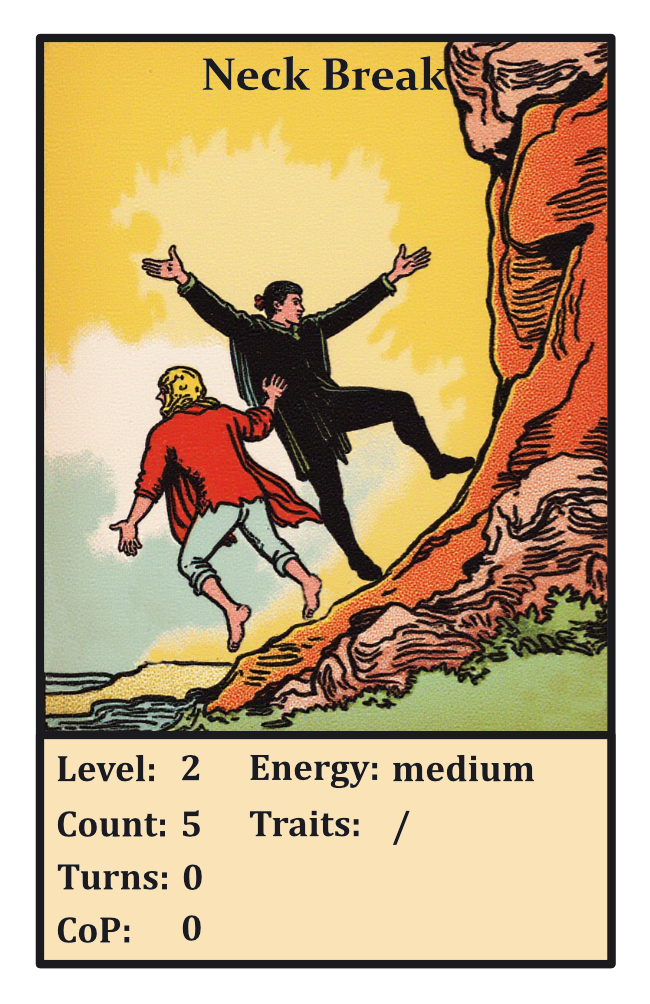
How to Play: Basic Trump Quartet
Players compete against each other by comparing a selected attribute on their top card. The player with the higher score wins.
- Shuffle the cards and distribute them evenly. If the total number is not divisible, remove extra cards to balance the decks.
- Players only see the top card of their deck.
- The player to the left of the dealer first selects an attribute and challenges another player: “Player 1 to Player 2: ‘Count 7’.” Player 2 answers with his value: “Count 2.”
4 The higher value wins. The winner takes the opponent’s card and places it at the end of their pile. - A player who has run out of cards loses and the player with the most cards wins.
In Case of a Tie: Both Players Draw a New Card The challenged player selects a new attribute, and the comparison continues until one player wins the round and takes all the used cards.
In Case of a Tie: Both Players Draw a New Card The challenged player selects a new attribute, and the comparison continues until one player wins the round and takes all the used cards.
Game Variations
After winning a duel, the player must show off the move to claim the cards. If the demo is wrong, each player keeps their own card and the round continues.
Players draw the top three cards from their deck. When challenged, they can play a card or combine two or three moves. In this case, the values for the selected attribute are added together. Only valid combinations in which the last rock step of a movement flows smoothly into the next are allowed. The handles must also be continuous.
After playing their cards, players must prove their routine. If a player is unable to complete the combination or the routine is invalid, the opponent wins all cards. If neither player is successful, they both lose their cards for that round.
After each duel, players draw new cards until they have three in their hand.